Menu Close

Kythira

The island of Kythira is located in the south of the Peloponnese where the Ionian, Aegean and Cretan seas are located.

According to Hesiodos, the goddess Aphrodite was born in the sea of ​​Kythira. Gea, wanting to punish her husband Uranus for forcing her to keep her children inside her womb, asked them to help him kill his father. Kronos asked his mother for a sickle and cut off his father’s genitals, which fell into the sea of ​​Kythira. From its foam, which was carried by the wind to Cyprus, was born Aphrodite.

In Kythira, it is worth visiting some of its typical villages like Fratsia, Mitata, Agia Pelagia, Livadi with its windmills, Avlemonas with its fortress and its beautiful beach. The fortresses of Chora and Agios Dimitrios. In the town of Mylopotamos, you can also visit the waterfall, the fortress and the cave of Agia Sofia. Other beaches on the island of Kythira are Kapsali, Melidoni, Limnaria, Diakofti and Kaladi.

The Venetian past

Kythira occupies a crucial geostrategic position. That was the key to all the countries to which it belonged throughout its history.

Christian churches, such as Agios Andreas in Livadi and Agios Dimitrios in Purco, were built in the 9th century. After the Fourth Crusade, the Venetians acquired Kythira, as well as other Greek islands and territories, in the 13th century. 

In 1207, the State of Venice establishes the Venier on the island. For many years Venier's patricians received Kythira and western Crete and dominated the region.

At the end of the third millennium, the Minoan civilization expanded its domain and took control of Kythira. Right after that, the Mycenaeans arrive on the island. The Dorians entered the scene around the 12th century BCE. C., with the disappearance of the Mycenaean kingdoms. The arrival of the Phoenicians, who manufacture the purple and dark red hue that is a highly desirable export product, is unknown. This is the time when Kythira is known as Porfyris or Porfyrisa.

In the middle of the VI century a. C., after the occupation of Mount Parnon, Sparta puts Kythira under her control. In 424 B.C. C., during the Peloponnesian War, the Athenians occupied the island in 421 with the peace of Nicias again granted to the Spartans. In the II century a. C., Kythira becomes independent and has its own currency.

Kythira is part of the Eastern Roman Empire since 395 AD. For more than three centuries, the island has disappeared from the sight of the rest of the world. As of 825, Crete is completely under the control of Arabs and Berber pirates, who raided and terrorized the Kythira Sea. Due to piracy and Arab intrusions into the eastern Mediterranean, the coastal region of the island could not be populated. The Byzantines, led by Nicephorus Fokas, recaptured Crete from the Arabs in 961. The Evdemonogianis of Monemvasia came to Kythira in the 12th century and stayed until 1204. The first urban settlement is that of Kolokithia, which is located in the present-day port of Agia Patricia; however, the castle was built in modern Paleochora.

Starting in 1207, Kythira and the Ionian Islands will be subject to Venetian control for the next six centuries. From 1275 to 1308, the Venier was exiled and the island was claimed by the Byzantines. However, after 1308, they return to the island to populate it with new inhabitants. The aristocratic class have established themselves in the new city of Kythira, which serves as the current capital. In the 16th century, the population was around 4,000 people. The population was fortified and organized against pirate incursions, establishing three urban poles. Agios Dimitrios in present-day Paleochora, Milopotamos in Kato Chora, and Chora, the current capital, are the three organized and fortified communities.

In 1537, the admiral of the Ottoman Empire and corsair of the Berber coasts Jeirredin Barbarossa burned and sacked Paleochora; His pirates massacre the civilian population and sell many of the kidnapped as slaves. Paleochora has been completely abandoned. During the last years of the Venetian occupation, the population exceeded 7,500 people. The island remained under Venetian control until Napoleon Bonaparte abolished its status in 1797. Since then, the island of Kythira and the rest of the Ionian islands have been in French hands thanks to the Treaty of Campo Formio. In 1797, Vincenzo Reno takes control of Kythira, and the new bourgeoisie, together with the peasants, burn the "Golden Book", the book of the nobility, in Stavromenos square.

In 1798, the French planted the Tree of Liberty in Chora's Stavromenos Square, proclaiming the values of the French Revolution, "Liberty, Equality and Fraternity". Meanwhile, the Kytherians begin their journey to Smyrna. Between 1798 and 1799, the Turks and the Russians formed an alliance to capture the Ionian Islands and Kythira. The islands are then transferred to the French for two years (1807-1809) until the British period, according to the Treaty of Tilsitt in 1807. On November 20, 1815, the Treaty of Paris established the "Republic of the Ionian Islands". », with Corfu as its capital.

During the Greek Revolution of 1821, many exiles from the Peloponnese gathered in Kythira, while others traveled to the Peloponnese to help in the battle for independence. After the unloading, many residents crossed the sea in search of work in the Greek free state, Crete or Izmir. The Ionian Islands joined Free Greece on May 28, 1864. Kythera was administratively part of the provinces of Argos and Corinth, as well as Laconia, but it also formed a separate province with Antikythira before joining the province of Attica, at the one that still belongs today.

Destinations

in the Ionian Islands

Kefalonia

Kefalonia which belongs to the Ionian Islands, has a rich cultural heritage along with impeccable scenery. Visit its impressive beaches and the famous caves and discover this fantastic island.

Corfu

In Corfu you will feel like you are in an Italian fairy tale. Let this beautiful island mesmerize you.

Ithaca

Ithaca, the home of Odysseus, an island with very little tourist development but of incredible beauty invites you to discover it. And surely, it is worth it!

Kythira

In the southern Peloponnese, Kythira is one of the islands that, despite its incredible beaches and important history, offers tranquility and the perfect vacation.

Lefkada

Lefkada is one of the islands accessible by car with incredible beaches of infinite blue and amazing towns.

Paxoi

Unusually green and still largely untouched, Paxoi (Paxos) has established a firm niche in Greece's tourism hierarchy
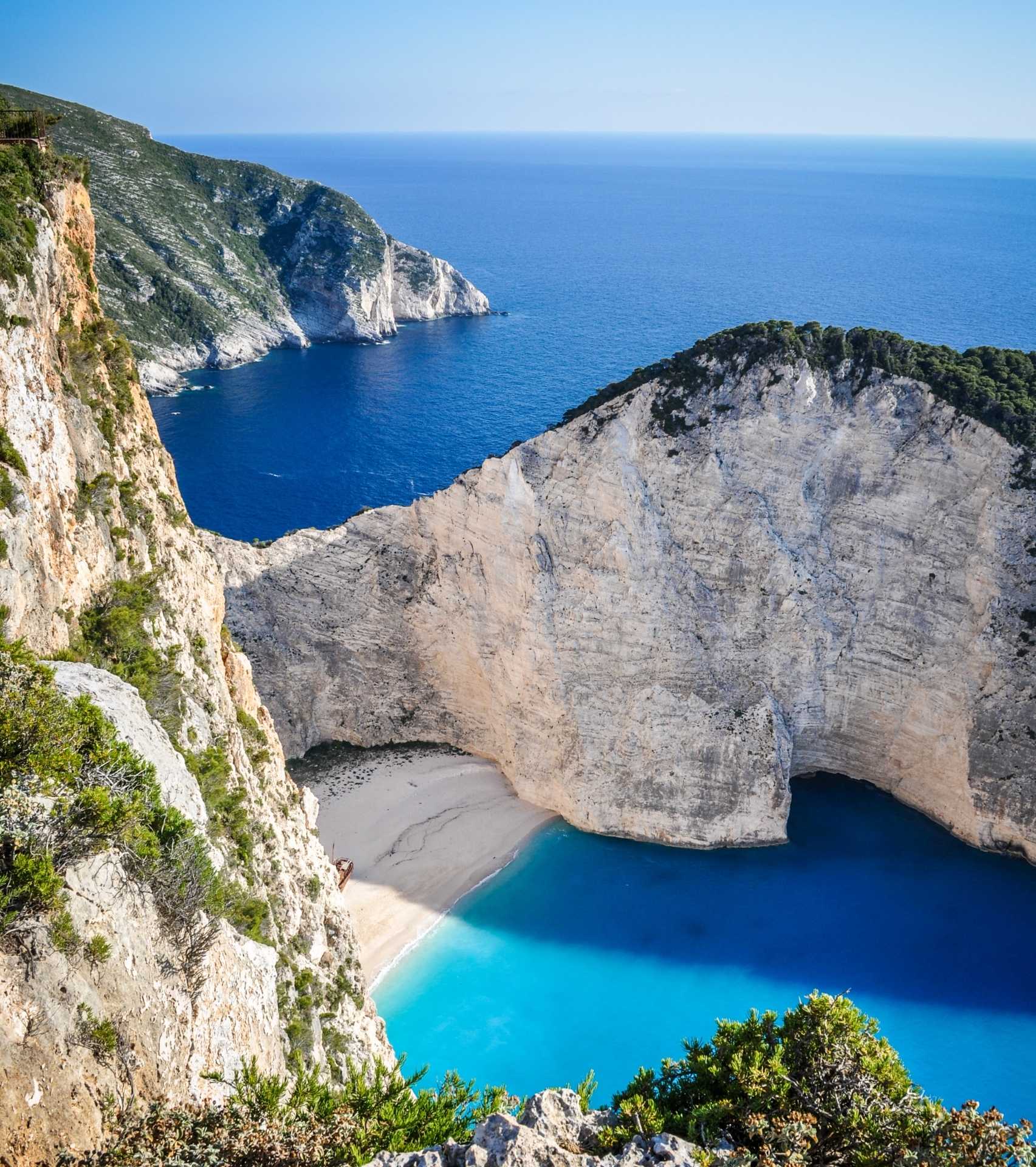
Zante (Zakynthos)

In addition to the Shipwreck, the most photographed beach in Greece, in Zante (Zakynthos) you will be amazed by its traditional character, hospitality and wonderful natural scenery.